Document Q&A Digital Assistant (RAG)
A retrieval-augmented assistant that answers questions about your own PDFs and notes from the passages it retrieves, cites them, and refuses to guess. Evaluated on 1,000 SQuAD 2.0 questions.
- Right passage ranked 1st for 88%
- Refuses 93% of off-topic questions
- 3 bugs found by its own evaluation
Problem
General-purpose language models don’t know a company’s private manuals, policies or notes, and retraining them every time a document changes isn’t practical. Retrieval-augmented generation (RAG) is the pattern most companies use for internal assistants: find the relevant passages first, then let the model answer only from them.
The first version (July 2026) was a working pipeline. This version asks the harder question: how well does it actually work, and when should it say “I don’t know”?
Data
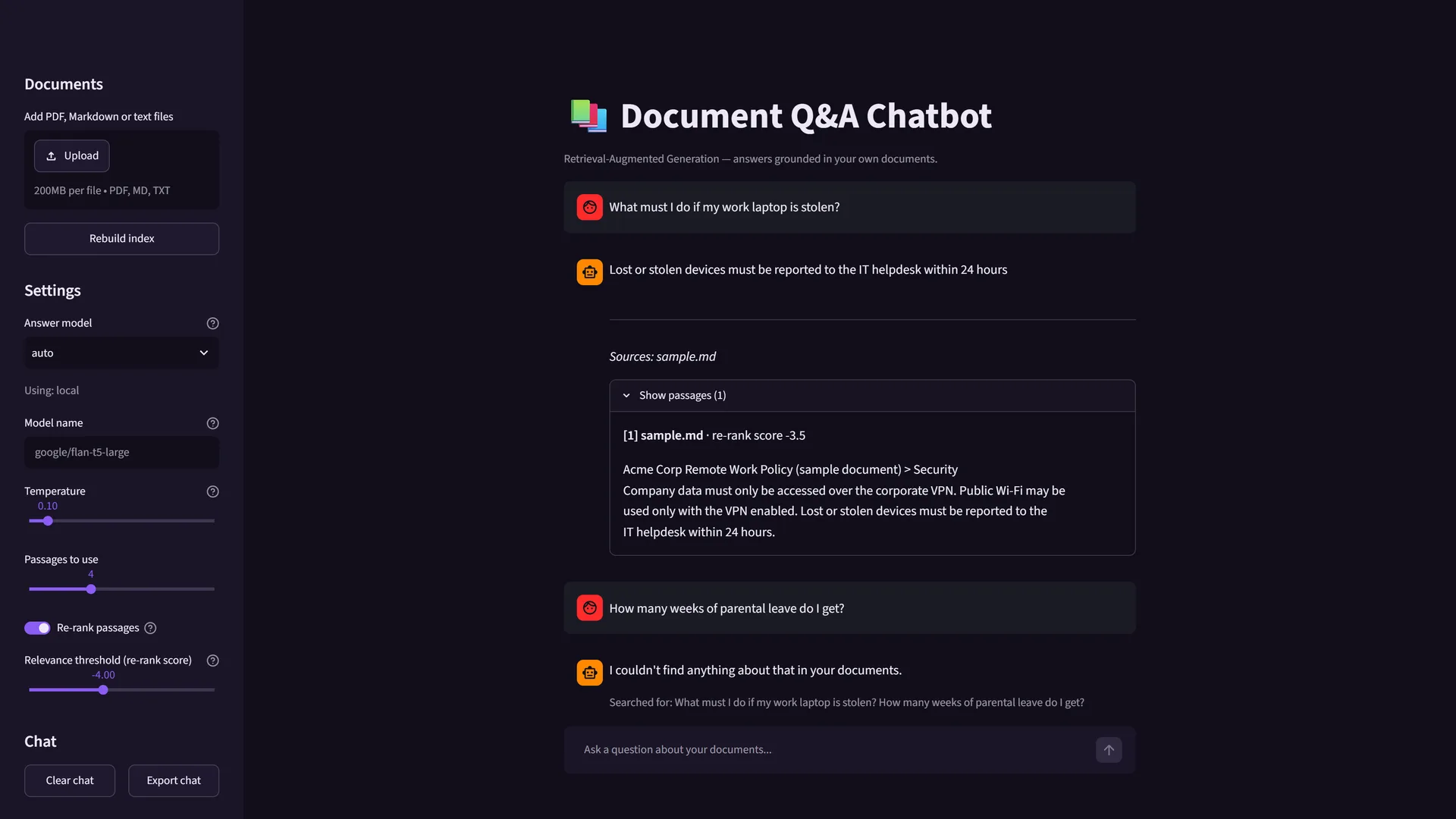
Private documents can’t be published, so the evaluation uses SQuAD 2.0 (Wikipedia paragraphs with crowd-written questions, CC BY-SA 4.0). 25 articles are indexed as the documents (1,149 chunks) and 10 more are held out, so their questions are about topics the assistant has never seen. The app itself works on any PDF, Markdown or text files; the screenshot above uses a sample remote-work policy.
Approach
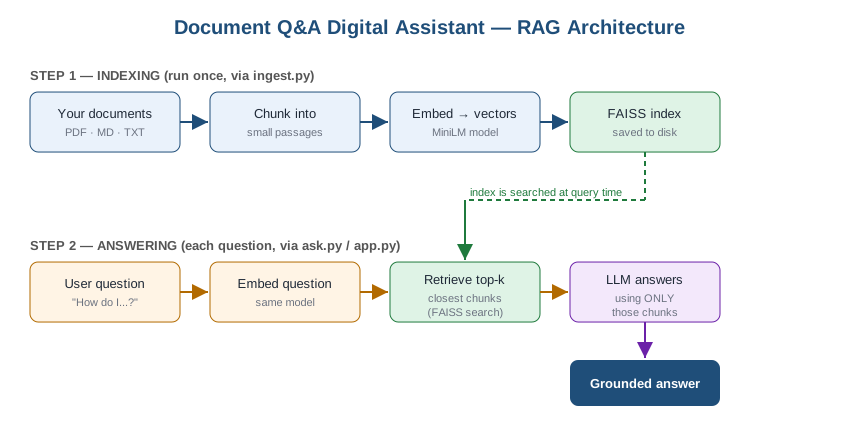
- Ingest and chunk. PDF, Markdown and text files are split into ~800-character passages
that never cross a section boundary and start with their section path
(
Remote Work Policy > Equipment). - Hybrid retrieval. Each question runs a vector search (
all-MiniLM-L6-v2embeddings in a FAISS index) and a BM25 keyword search; the two rankings are merged with reciprocal rank fusion. - Re-rank and refuse. A cross-encoder (
ms-marco-MiniLM-L-6-v2) scores every candidate against the question. If the best passage is below a relevance threshold, the app says it couldn’t find anything, without calling the language model. - Generate with citations. The answer comes from the first available of Claude, OpenAI,
a local Ollama model, or a free local
flan-t5-large, so the app runs at zero cost out of the box. Follow-up questions are rewritten into standalone ones from the chat history. - Use it from the command line or a Streamlit chat UI with streaming answers, numbered citations and a “Show passages” panel under each answer.
The evaluation (python -m evaluation.run_eval) calls the same retrieval and answer code the
app uses, so it measures the real pipeline, and 22 unit tests run without downloading any
model.
Results
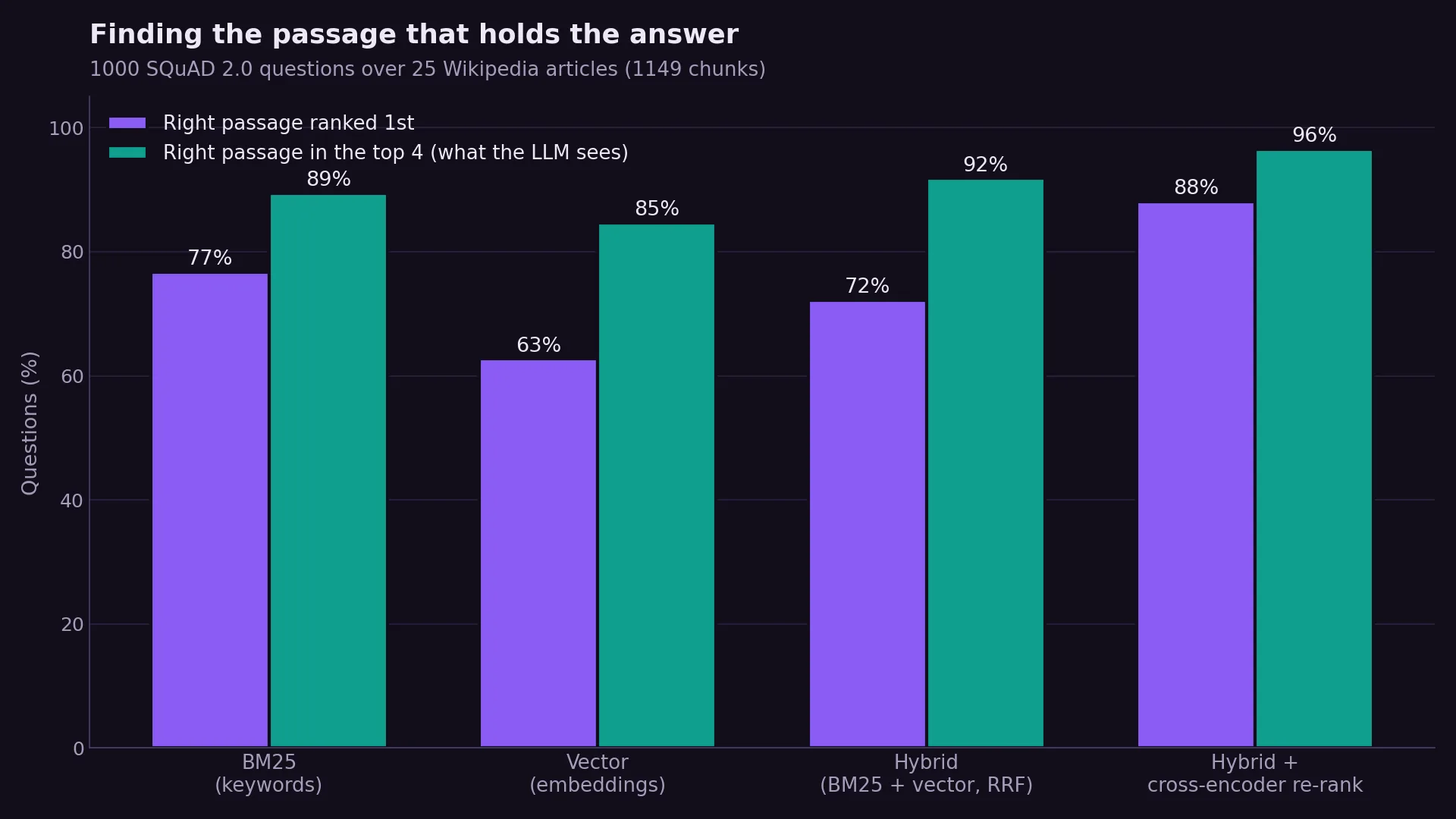
Finding the right passage. On 1,000 questions, hybrid search plus re-ranking puts the right passage first for 88.1% and in the top four (what the model sees) for 96.5%. BM25 alone reaches 76.7%, vector search alone 62.7%.
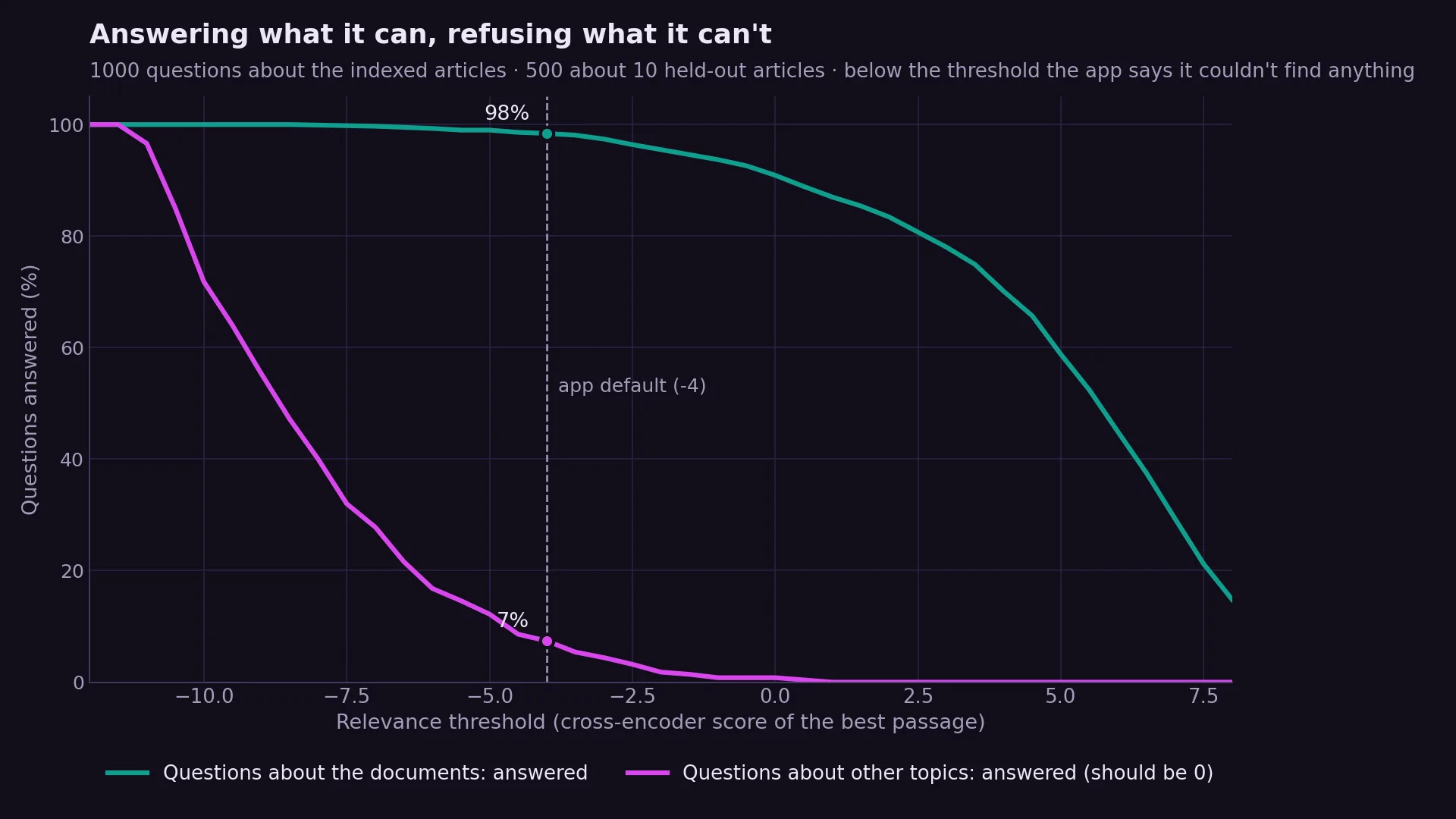
Refusing to guess. The threshold was set from this curve rather than by feel. Raising it to −2 refuses 98% of off-topic questions but drops coverage to 95.5%. Without re-ranking, the cosine-similarity threshold is far weaker: it still answered 38% of the off-topic questions.
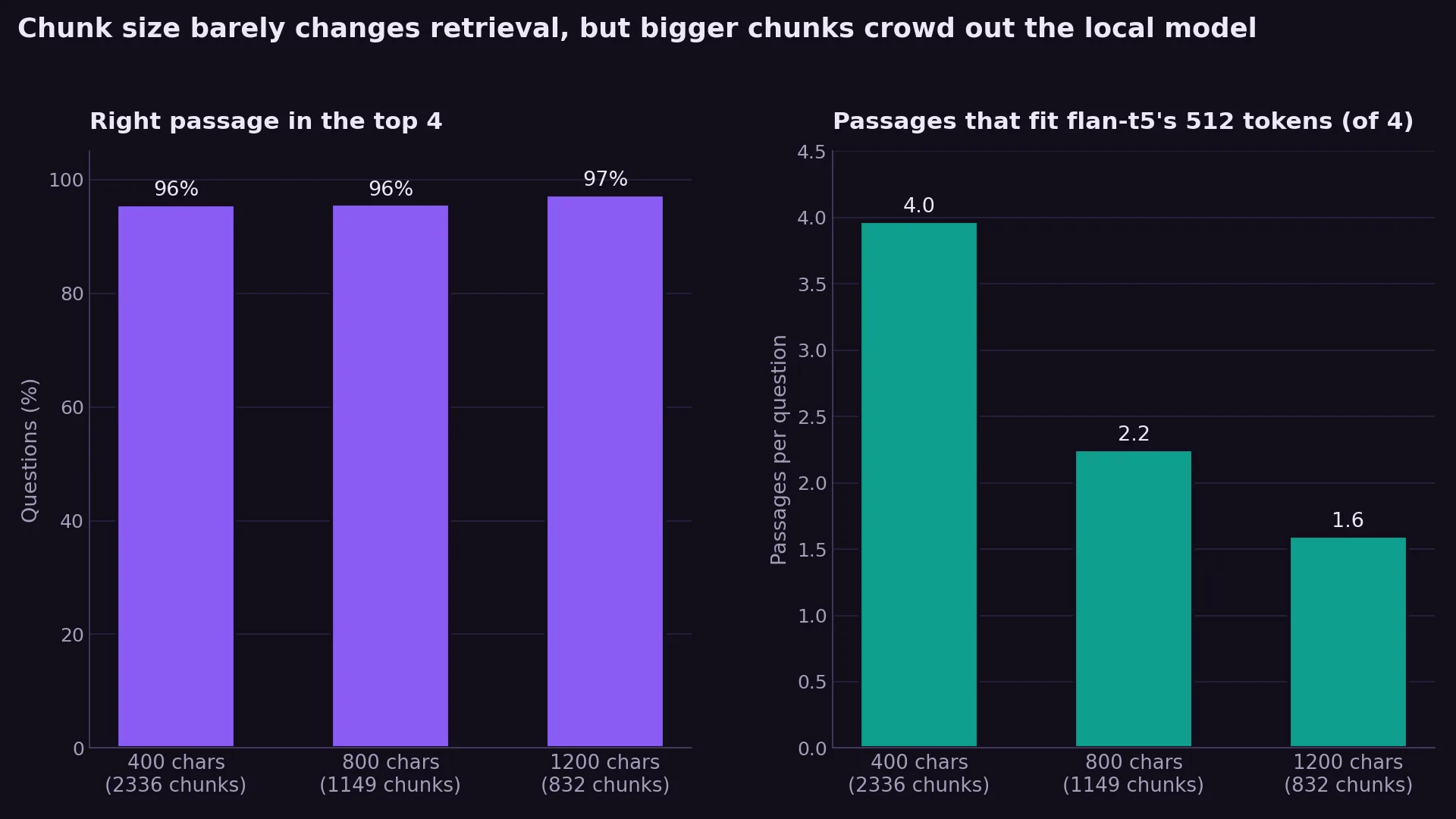
Answers from the free local model. On 100 answerable questions flan-t5-large scores
84% exact match and 90.6% token F1, with about 6 seconds per answer on a laptop CPU.
Its weak spot is on-topic questions that have no answer in the text: it declines only 24%
of them and invents an answer for the rest. The threshold protects against off-topic
questions; catching on-topic unanswerable ones depends on the answer model, which is a reason
to use Claude, OpenAI or Ollama for anything that matters.
Three bugs the evaluation found, and fixed:
- Hybrid search was really vector search. With re-ranking off, the results were re-sorted by cosine similarity, which silently threw away the BM25 half. “Hybrid” scored exactly the same as vector search. The fix lifts the top-four hit rate from 84.7% to 91.8%.
- A memory leak in the local model. Every answer started a new thread, and PyTorch kept about 80 MB per thread; after 150 answers the process had grown past 20 GB and crashed. Answers now run on one reused worker thread and memory stays flat.
- A hang on model errors. If the local model failed, the error was swallowed on the worker thread and the app waited forever. It is now raised to the caller.
Caveat. The embedding model and flan-t5 were both trained partly on SQuAD, so the absolute
numbers are optimistic. The comparisons between methods, thresholds and chunk sizes are the
useful part.
What I learned
- Measure instead of assuming. The evaluation showed which component earns its keep (the re-ranker), how to set the refusal threshold from data, and that chunk size should depend on the answer model’s context length.
- A bug can be invisible in manual testing. The hybrid search looked fine in the chat UI; only a 1,000-question comparison revealed it was doing nothing.
- Refusing is a feature, and it has two halves. A relevance threshold handles off-topic questions well; on-topic questions with no answer need a stronger model.
- Long-running evaluation is where resource bugs show up. The memory leak and the hang never appeared in a short demo.
Next steps: a hosted vector database (Chroma or Pinecone) and deploying the Streamlit app.