EMG Muscle Fatigue Classification
Can surface EMG detect muscle fatigue in someone the model has never seen? 9,540 signal windows from 14 people, leave-one-subject-out testing, and an honest answer: not yet.
- 9,540 windows, 14 subjects
- Leave-one-subject-out
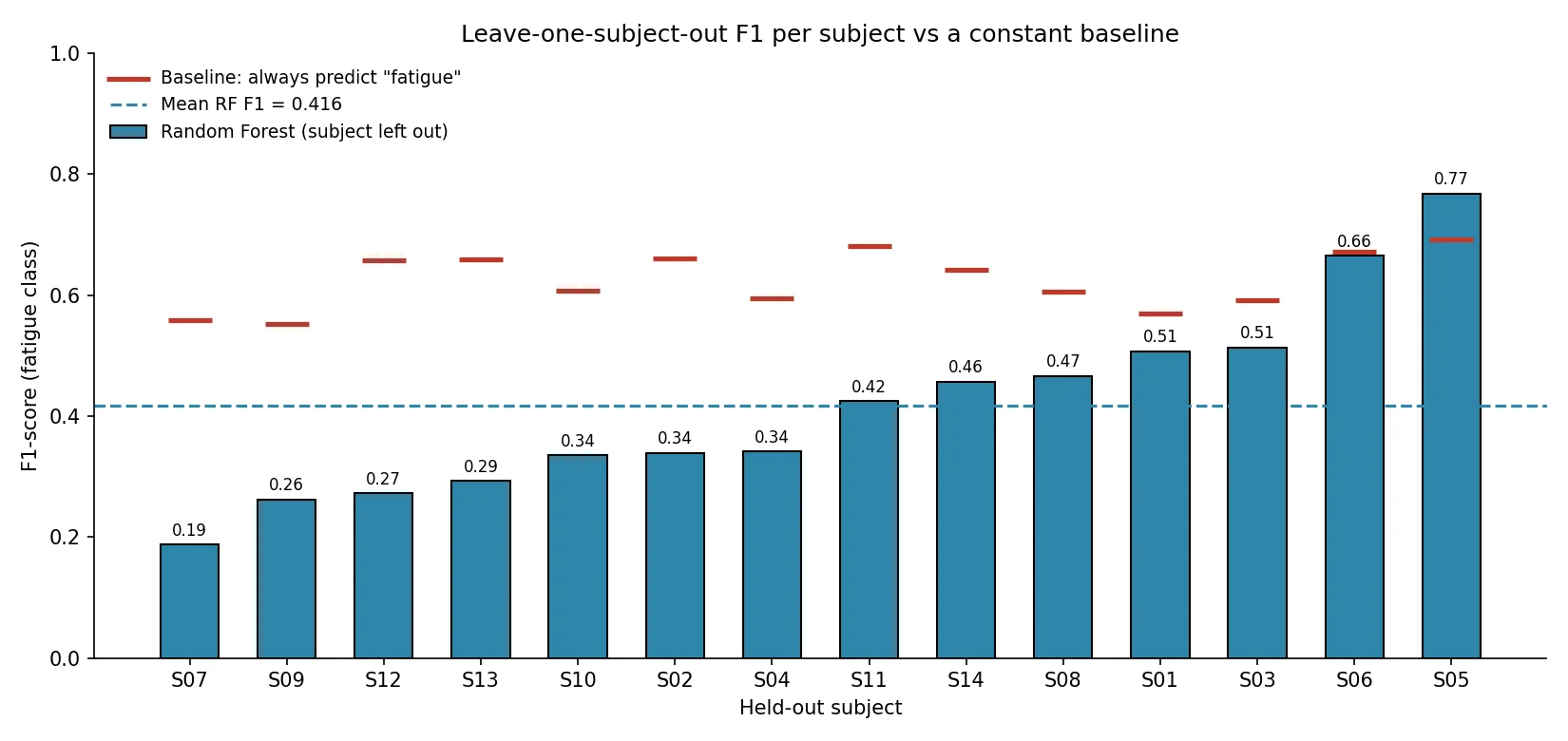
- Mean F1 0.416 vs baseline 0.625
Problem
Muscle fatigue changes the electrical signal a muscle produces, which surface EMG can measure. A fatigue detector is only useful if it works for new people without recalibration. This M.Sc. project (AI Discovery course) asks whether that is possible with simple, explainable signal features.
Data
154 recordings from 14 people, each about 60 s at 5 kHz, in a fatigue and a non-fatigue condition. Subjects are anonymised as S01–S14, and the recordings are not published.
Approach
- Filtering: 20–450 Hz band-pass, rectification and a 50 ms RMS envelope.
- Activity detection: an adaptive threshold finds 1,022 muscle bursts.
- Windowing: 250 ms windows with 50% overlap → 9,540 windows (4,335 fatigue, 5,205 non-fatigue).
- Features: 10 per window, in the time domain (RMS, MAV, waveform length, zero crossings, slope sign changes) and frequency domain (mean and median frequency, spectral entropy).
- Evaluation: leave-one-subject-out, so the model is always tested on a person it has never seen, with scaling fitted inside each fold. Logistic regression and random forest.
Results
At group level the features differ. Amplitude features are about 19% lower in the fatigue recordings and median frequency is 2% higher (all 10 features: Mann-Whitney p < 10⁻⁹). That is the opposite of the textbook fatigue pattern, which points to the recording protocol rather than physiology.
For an unseen person, the classifier does not beat a trivial baseline.
| Model (leave-one-subject-out) | Accuracy | F1 (fatigue) |
|---|---|---|
| Logistic regression | 0.465 | 0.460 |
| Random forest | 0.540 | 0.416 ± 0.161 |
| Always predict “non-fatigue” | 0.544 | 0 |
| Always predict “fatigue” | 0.456 | 0.625 |
The differences between people are larger than the fatigue effect, so a model trained on 13 people does not transfer to the 14th.
What I learned
- Compare against a trivial baseline before reporting a score. On its own, an F1 of 0.416 sounds like a weak model. Next to 0.625 for “always fatigue”, it is clearly no model at all.
- Validation design decides the answer. Splitting windows at random would put the same person in training and test data, so the model could recognise people rather than fatigue. Leaving whole subjects out tests what matters.
- Check the labels against physiology. The features moved in the opposite direction to known fatigue effects, so the next step is a protocol that reliably induces fatigue, and normalising each person’s features against their own rested baseline.