NLP News Intelligence
Classical ML, Sentence-BERT embeddings and LDA compared on 127,600 AG News articles for classification, semantic search and topic discovery.
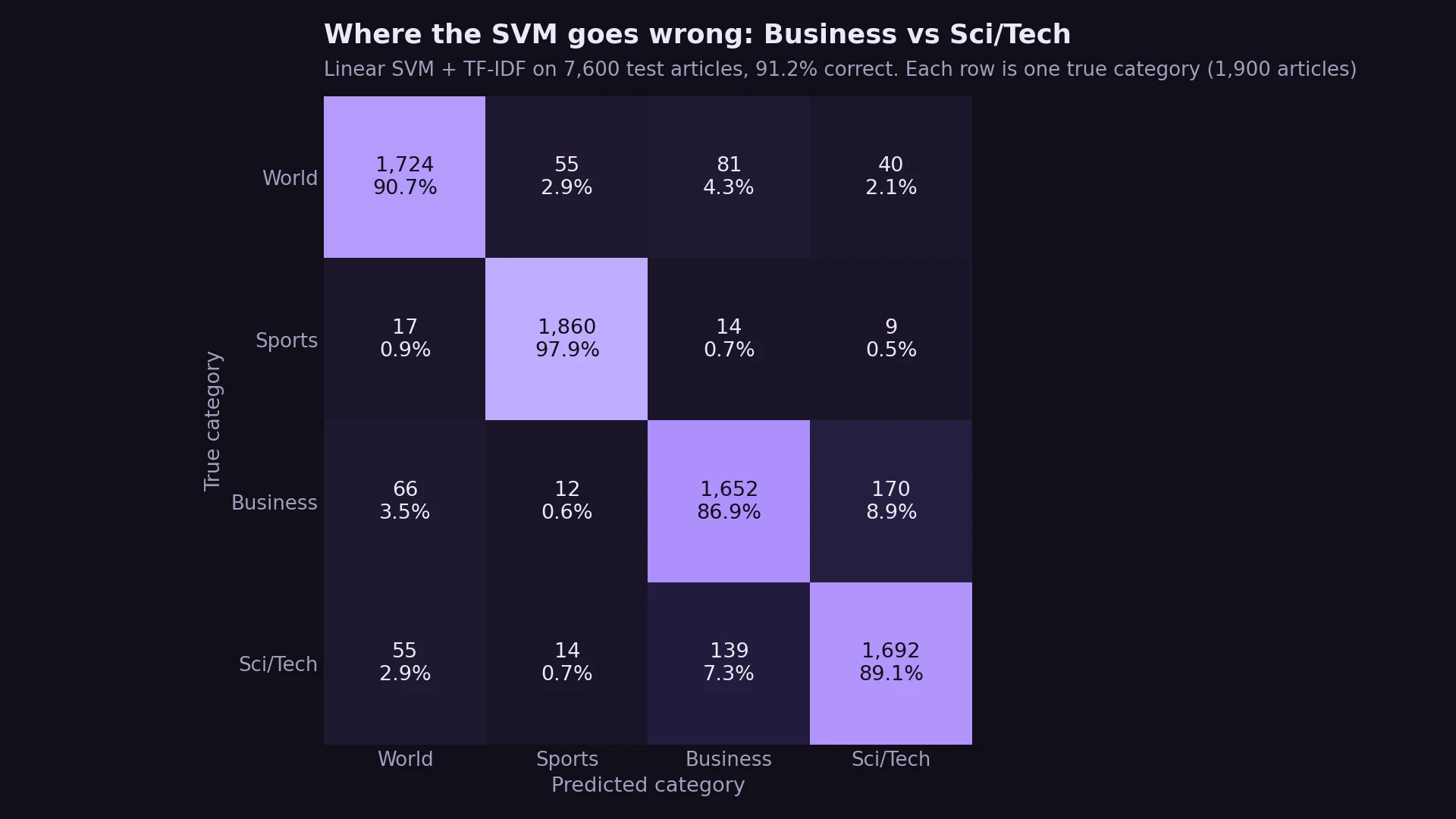
- 91.2% test accuracy
- P@5 0.844 semantic search
- Labels recovered by LDA
Problem
Newer models aren’t automatically better. I wanted to measure where classical NLP still wins and where neural embeddings earn their cost, using one dataset and three tasks: classifying news articles, searching them by meaning, and discovering topics without labels.
Data
AG News: 120,000 training and 7,600 test articles in four balanced categories (World, Sports, Business, Sci/Tech).
Approach
- Classical: TF-IDF features with Logistic Regression and a Linear SVM.
- Neural: Sentence-BERT embeddings with Logistic Regression for classification, and cosine-similarity retrieval for semantic search.
- Unsupervised: LDA with 4 topics, cross-tabulated against the true labels.
- One evaluation notebook compares all paradigms on the same held-out test set.
Results
Classification (7,600 test articles)
| Model | Accuracy |
|---|---|
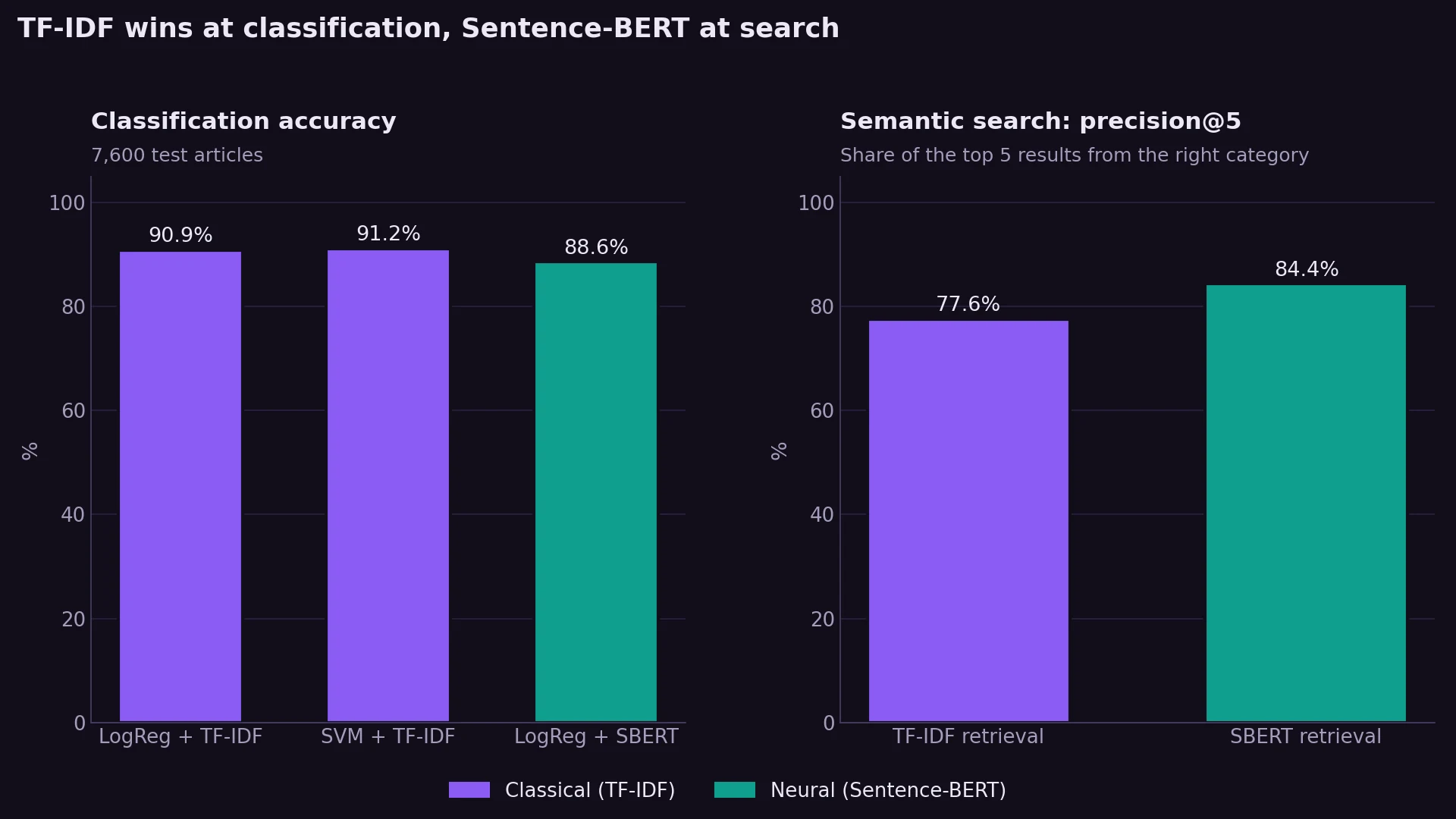
| Linear SVM + TF-IDF | 91.16% |
| Logistic Regression + TF-IDF | 90.87% |
| Logistic Regression + SBERT | 88.58% |
Semantic search (Precision@5)
| Method | P@5 |
|---|---|
| SBERT retrieval | 0.844 |
| TF-IDF retrieval | 0.776 |
TF-IDF breaks on vocabulary mismatch. The query “Apple launches AI chip” pulls in Beatles articles because of the word Apple. SBERT returns AMD, Intel and NVIDIA stories that share no keywords with the query but match its meaning.
Topic modeling: without seeing any labels, LDA recovered the four real categories (e.g. game, team, season → Sports; stock, oil, percent → Business).
What I learned
- Match the method to the task. TF-IDF won at classification because AG News categories are separable by keywords. SBERT won at retrieval, where meaning matters more than exact words. A hybrid system is justified.
- Comparing paradigms side by side surfaces trade-offs that a single-model project would miss.